Reading a Pause in a Comic Exchange
Learn how to read a pause in a comic exchange, identify what changes during the silence, and revise beats that delay a joke without sharpening it.
The most common mistake when reading a pause in a comic exchange is treating every silence as a sign that a punchline is coming. That assumption can make a scene feel sluggish: the audience waits, but the characters and the comic situation remain exactly where they were. To read a pause in a comic exchange, ask what the silence changes before deciding whether it earns its place.
What changes during a pause?
A pause is comic when the audience uses it to revise an expectation, notice a character’s response, or anticipate a consequence. The dialogue stops, but the exchange keeps moving. A character may understand an insult a moment late, realize that an answer has made things worse, or wait for approval that is not coming.
That change does not need to be large. A glance at a muddy shoe can shift the scene from a confident explanation to a strained attempt at denial. The pause creates room for the audience to register the contradiction: the speaker says the floor is clean while standing in the evidence.
By contrast, a silence that only marks “something funny should happen here” does not give the audience anything new to perceive. It can make a line feel artificially important, as if the script is holding up a sign that says laugh now. The useful question is not how long the pause lasts. It is what becomes clearer, stranger, or more inevitable while it lasts.
What does the audience expect next?
Read the lines immediately before the pause and name the prediction they invite. Is a character about to answer a direct question? Is someone waiting to be praised? Does a boast leave a gap for the listener to challenge it? A pause sharpens anticipation when it lets the audience recognize that the expected response is coming under pressure.
Then compare that prediction with what follows. If the next line merely delivers the answer the audience already expects, the silence may have stretched a familiar exchange without adding tension. If the pause makes a simple answer feel risky, evasive, or revealing, it has changed the audience’s relationship to that answer.
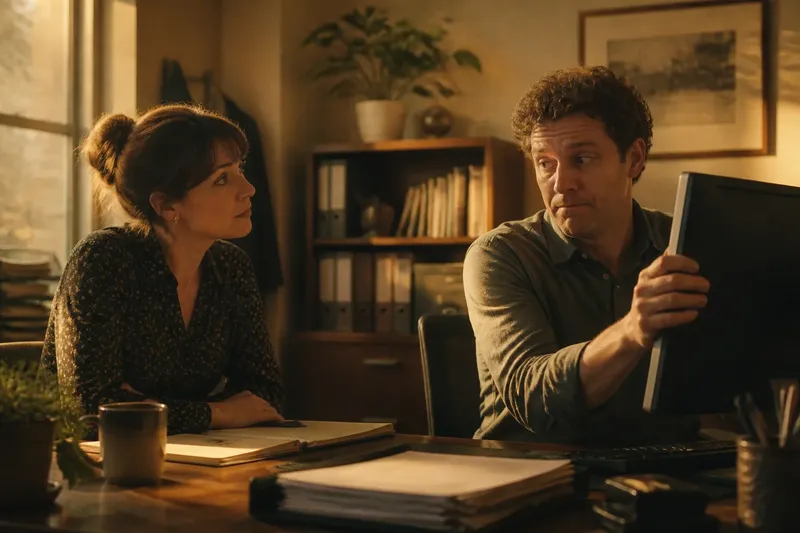
Imagine a fictional office exchange: Lena asks, “Did you send the draft to the client?” Her colleague, Owen, looks at the open email window and says nothing. If the next line is simply “Yes,” the pause may be empty unless the scene has shown a reason to doubt him. If he slowly turns the monitor away before answering, the silence gives the audience a concrete reason to anticipate a lie. The action alters the expected meaning of his reply; the pause is not doing all the work by itself.
Is the silence active or empty?
An active pause contains behavior the audience can read. The character may keep smiling after a failed joke, inspect an object with exaggerated care, or wait for another person to rescue the conversation. The behavior gives the silence a point of view. It can expose what the character wants without adding an explanatory line.
An empty pause often has no visible or audible event beyond the absence of speech. That can be an intentional choice, but it becomes difficult to distinguish from delay if nothing in the exchange changes. On the page, a parenthetical such as “(beat)” cannot establish the meaning on its own. The surrounding lines and stage business have to make the beat legible.
Try describing the pause with a verb: withholds, waits, reconsiders, listens, refuses. If no useful verb fits, the silence may be decorative. This is a reading tool, not a rule that every pause requires a gesture. Stillness can be active when the audience understands what a character is waiting for or refusing to say.
Does the beat belong to the character?
A pause should usually make sense as something the character would do, not just something the writer needs for timing. A person might hesitate because an answer threatens their self-image, because they have missed an implication, or because they expect the other person to speak first. Those motives produce different comic meanings even if the silence occupies the same space on the page.
Ask who controls the beat. If one speaker pauses to make another person uncomfortable, the silence is an action in the relationship. If a listener takes time to understand an obvious statement, the laugh may come from delayed comprehension. If everyone stops because the writer wants a laugh, the exchange risks feeling staged rather than inhabited.
Also notice whose response the silence invites the audience to watch. A pause after a boast may focus attention on the person being boasted about. A pause after a mistake may keep attention on the speaker, who has not yet realized the mistake was noticed. The beat can direct the audience’s attention as precisely as a line can, but it needs a clear target.
When does a pause sharpen anticipation?
A pause sharpens anticipation when it narrows the audience’s predictions while making the outcome more charged. The audience may know that someone must respond, but not whether the response will be honest, defensive, or disastrously confident. The silence lets those possibilities gather around a specific choice.
Look for a pressure point: a question that cannot be dodged without consequence, a claim that has just met visible evidence, or a social expectation that one character is refusing to satisfy. If the pause holds attention on that pressure, the next line lands with more meaning because the audience has watched the character approach it.
Anticipation is not the same as simply waiting longer for a punchline. A long beat can weaken a joke if it gives the audience enough time to predict the wording and lose interest. A brief beat can be potent if it makes the character’s decision visible. In a performance, the actor’s focus and the scene’s rhythm help determine the length; on the page, a writer can indicate the relevant action rather than prescribe an exact duration without context.
When does a pause slow dialogue?
A pause slows dialogue when it delays information or response but does not alter the audience’s understanding of the exchange. If the next line would mean the same thing without the silence, and nothing happens during the beat, the pause may be adding duration rather than comic pressure.
Read the exchange aloud at a natural conversational pace, then read it again without the marked silence. Compare what each version makes you expect. If removing the beat does not change the focus, the character’s behavior, or the impact of the reply, consider cutting it or giving the character a meaningful action.
Do not automatically remove a pause just because it produces no laugh on the page. A silence may be needed to let an audience notice an expression, recognize a contradiction, or recover from an earlier comic turn. The question is whether it supports a distinct response. If it merely repeats the waiting already built into the lines, it is likely redundant.
How can you mark a beat clearly?
Use the least instruction that makes the beat readable. Sometimes the dialogue already gives the audience a reason to pause. Elsewhere, a small action can show what the silence is doing: a character shuts a folder, studies the wrong name tag, or continues nodding after the other person has stopped speaking. Choose an action that belongs to the character and changes the exchange’s focus.
Keep separate kinds of silence distinct in the script. A character thinking, refusing to answer, and failing to recognize a joke are not interchangeable. If each is marked with the same generic beat, actors may have to guess at the comic intention. A concise cue tied to an observable action often communicates more than an abstract instruction to “wait for a laugh.”
For prose, description can carry the same information without interrupting the scene’s voice. Instead of repeatedly announcing that nobody speaks, show what a character attends to during the gap. A sleeve being smoothed for the third time, for instance, can make anxious composure visible. The detail should reveal the character or sharpen the moment, not decorate the silence.
What should you ask while revising?
Use these questions when checking a comic exchange. They are prompts for making a specific revision, not boxes every pause must satisfy:
- What is the audience expecting? Identify the response the preceding line seems to call for.
- What changes before the next line? Look for a shift in attention, status, understanding, or intention.
- What does the silent character want? Name the action behind the silence, even if the character does not get what they want.
- What can the audience observe? Find a visible behavior, a telling absence, or a clear conversational pressure.
- What happens if the beat is cut? Keep it when removing it blurs the comic meaning or weakens the audience’s anticipation.
Answering these questions can also reveal that the pause is in the wrong place. A beat before the audience understands the contradiction may leave them confused; a beat after they have already understood it may hold the scene past its natural response. Place the silence where it makes the audience notice the change, rather than where the page happens to have room.
Can a pause be funny without a punchline?
Yes. A pause can carry a comic response on its own when the audience recognizes the character’s predicament or attitude. Someone maintaining a grandly formal posture while waiting for a paper cup to stop leaking can be funny without a new line, provided the scene has made the mismatch clear.
Silence can also function as a refusal. A character who declines to respond to an absurd demand may expose the demand’s absurdity more sharply than a clever retort would. The audience reads the gap as judgment, embarrassment, or deliberate noncooperation, depending on the relationship and the behavior that surrounds it.
For a useful reading of a pause in a comic exchange, follow what the audience notices during the silence: a prediction forming, a character’s motive surfacing, or a contradiction becoming impossible to ignore. If none of those occurs, the beat probably needs a clearer action or a cleaner cut. Treat the silence like a held door: it matters because of who is trying to pass through, who is holding it, and what changes before it closes.